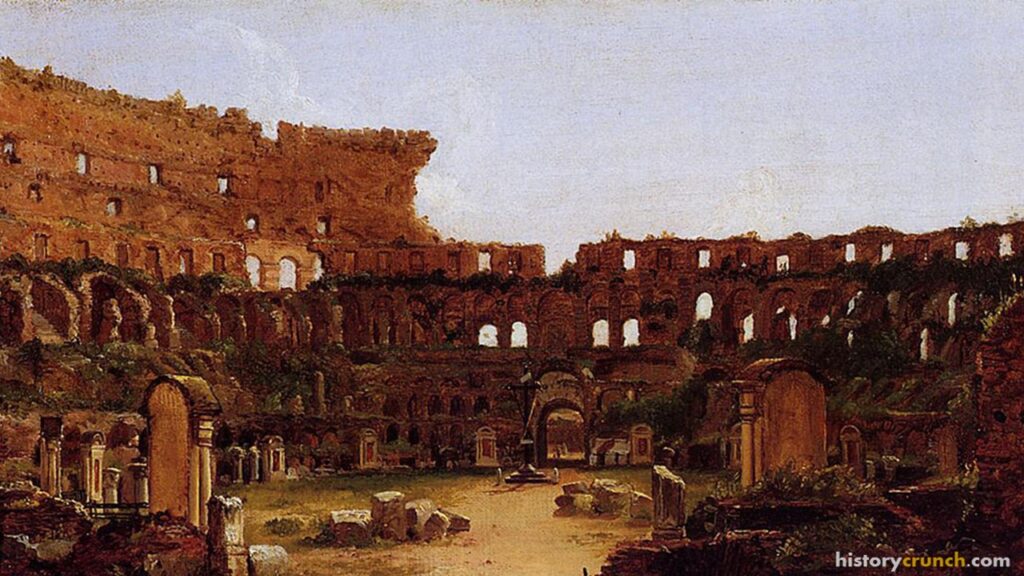
The Colosseum of Ancient Rome is one of the most famous structures of the Roman Empire. Located in the heart of the city of Rome, the Colosseum was highly significant for its architecture, and cultural impact on Ancient Rome. In fact, it was a center for entertainment and other cultural events. Today, the Colosseum is recognized as a UNESCO World Heritage Site, which highlights its significance in world history.
COLOSSEUM – CONSTRUCTION
The Colosseum was built between 70 CE and 80 CE. and was ordered to be built by Emperor Vespasian who ruled over Rome from 69 CE to 79 CE. His family name was ‘Flavian’; therefore the original name of the Colosseum was the Flavian Amphitheater.
The construction of the Colosseum was a significant example of the engineering skill of the Ancient Romans. In fact, it was the largest amphitheater ever built in the Roman Empire and was capable of seating between 50,000 and 80,000 people. The entire structure of the Colosseum was built using concrete, volcanic stone and travertine limestone. These materials made the Colosseum both strong and flexible, which has allowed it to endure as a structure into modern day. The Colosseum’s design was based on a series of arches and vaults, which distributed weight evenly and allowed for its massive size and stability. In fact, the outer wall of the Colosseum was nearly 160 feet (50 metres) high and contained three tiers of arches that were each framed by columns in different architectural styles. For instance, Doric was the style on the first level, Ionic was the style on the second and Corinthian was the style on the third level.
As well, the Colosseum included 76 separate entrances that allowed Romans to access the maze of staircases, ramps, arcades and passageways inside. Under the Colosseum, unseen from the outside, were a series of animal pens and rooms for the gladiators who would participate in the Roman “games”. This area under the Colosseum was referred to as the ‘hypogeum’. Trapdoors and lifts could suddenly raise wild beasts or warriors into the arena, adding surprise and excitement to the shows. The seating area was covered from the sun by a large, stretched out awning, which was called the ‘velarium’.
COLOSSEUM – GAMES AND OTHER EVENTS
Every Roman town had an amphitheater which was a large stadium in which entertainment and Roman ‘games’ would take place. The largest and most famous Roman amphitheater was the Colosseum in Rome. In fact, it is also one of the most famous structures in all of Ancient Rome.
Much of the entertainment that took place inside the Colosseum was violent and bloody. It hosted a wide variety of spectacles, including gladiatorial combat, animal hunts, executions and re-enacted naval battles The ‘games’ were often paid for by the emperor and were free to attend. This made the games an important aspect to the political control of the emperor. Historians have argued that not only would the games make him popular but it also allowed the Roman people to focus on the violence of the ‘games and, as such, they were much less likely to rebel or revolt against the Roman government. For instance, during the opening games in 80 CE, Emperor Titus reportedly carried out shows that lasted 100 days and featured thousands of animals and gladiators.
The entertainment inside of the Colosseum consisted mainly of fights between humans and animals. For example, battle between gladiators was a popular form of entertainment that many Romans enjoyed. Also of note, the Colosseum was large enough that its main area could be flooded and Romans could enjoy re-enacted naval battles.
COLOSSEUM – SIGNIFICANCE
As stated above, the Colosseum was a highly significant structure in Ancient Rome. It symbolized the power and unity of the Roman Empire and essentially served as a way for emperors to control and entertain the Roman people. The Colosseum showcased Rome’s wealth, engineering skill and overall organizational skill. As mentioned previously, it also served as a tool of the emperors and their control over ancient Roman society. For example, emperors used it to strengthen their relationship with the public through free games and food. Historians have argued that by satisfying the ancient Roman population with games and other events the emperors were more easily able to maintain order and loyalty within a vast empire.
Today, the Colosseum stands not only as a UNESCO World Heritage Site but also as a monument to the ancient Roman Empire.