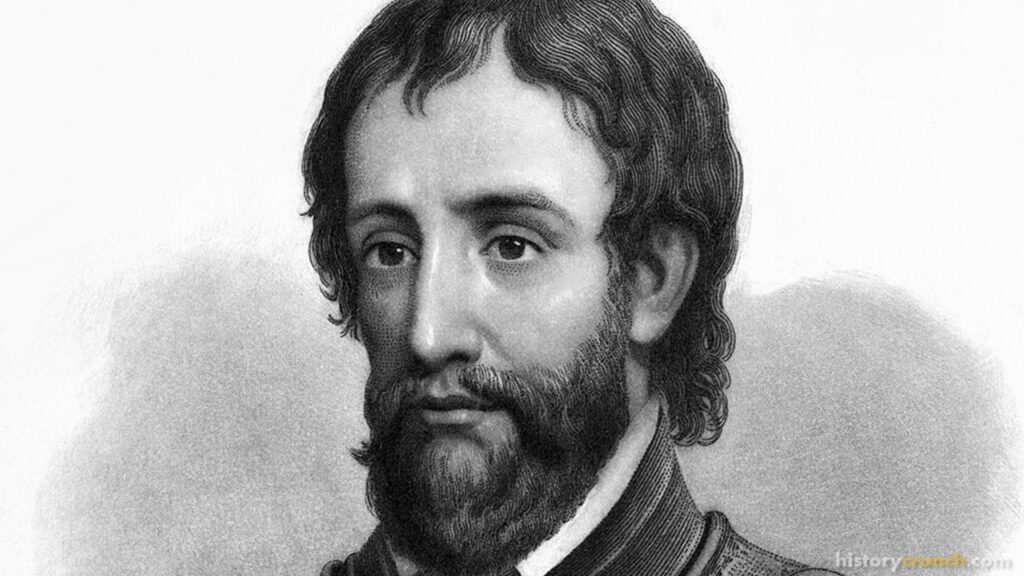
Hernando de Soto was a Spanish conquistador and explorer who played an important role in the early Spanish exploration of the Americas. For instance, he is best known for his expedition through the southeastern region of modern United States and for being the first European to cross the Mississippi River. As such, he was a central figure during the Age of Exploration.
HERNANDO DE SOTO – EARLY LIFE
Hernando de Soto was born sometime between 1490 and 1500 in Jerez de los Caballeros, Spain. The exact date of his birth is unknown. De Soto’s parents were relatively poor, and he moved around a lot with them as they tried to find work. Like many of the young people at the time, De Soto heard of the possible fame and fortune that came to explorers of the New World. As a result, he traveled to the New World as a young man, where he quickly proved himself as a skilled horseman, conquistador and leader. In fact, his early career was marked by involvement in the conquest of Central America.
HERNANDO DE SOTO – VOYAGES IN THE AGE OF EXPLORATION
As stated above, Hernando de Soto was a significant figure in the Age of Exploration. In fact, de Soto sailed to the New World on a number of voyages that resulted in the Conquest of Central America, and the Spanish colonization of the New World.
On his first voyage, Hernando de Soto sailed with Pedro Arias Davila, who was the first Governor of Panama. Then, in 1520, de Soto went on the expedition to Vegarua and in 1524 he set sail under Francisco Hernandez de Cordoba to Nicaragua. De Soto developed many important skills and became known for being a brave leader, loyal to his men and for his ruthless schemes. Over time, these things became his hallmarks during the Conquest of Central America. He also developed skills as a horseman, fighter, and tactician and became famed for these things.
De Soto’s reputation rose further when he joined Francisco Pizarro in the conquest of the Inca Empire in the early 1530s. He played a key role in diplomatic negotiations and military operations, including the capture of the Incan emperor Atahualpa. As a reward, de Soto received a large share of the Inca ransom and returned to Spain in 1536 as a wealthy and celebrated man.
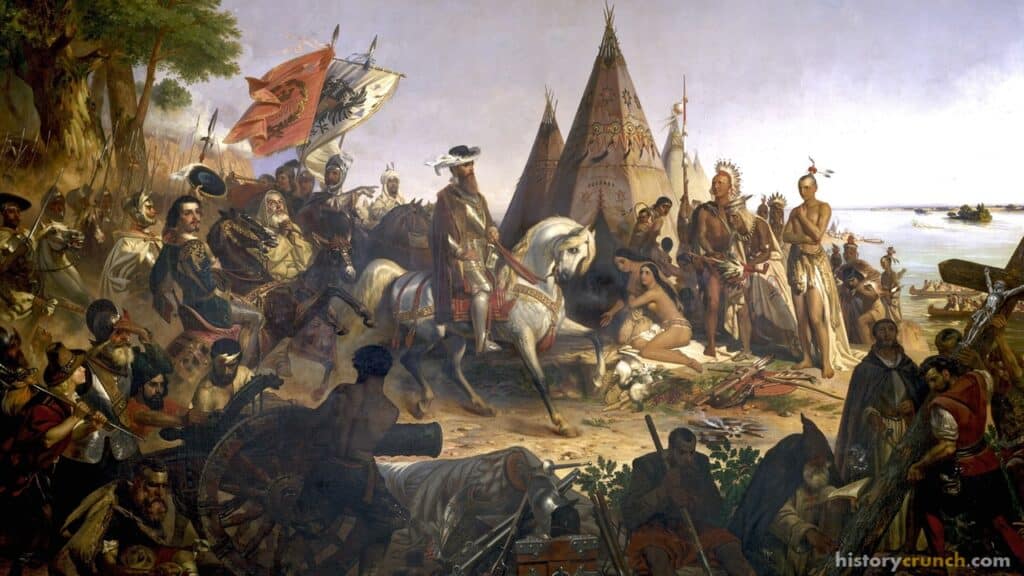
With that said, Hernando de Soto is best remembered today for his expedition to North America in 1539. In fact, de Soto led the first European expedition to the then unexplored southern states of the United States. He first landed in the area of Tampa Bay, Florida, with a well-equipped expedition of about 600 men, horses, and supplies. Over the next three years, his forces marched through present-day Florida, Georgia, South Carolina, North Carolina, Tennessee, Alabama, Mississippi and Arkansas. Along the way, de Soto’s men clashed with numerous Native American tribes and regularly used violence to gather information or food from the tribes. For instance, his forces burned villages, enslaved people, and unknowingly introduced European diseases, which would go on to have profound impacts on the indigenous people of the region.
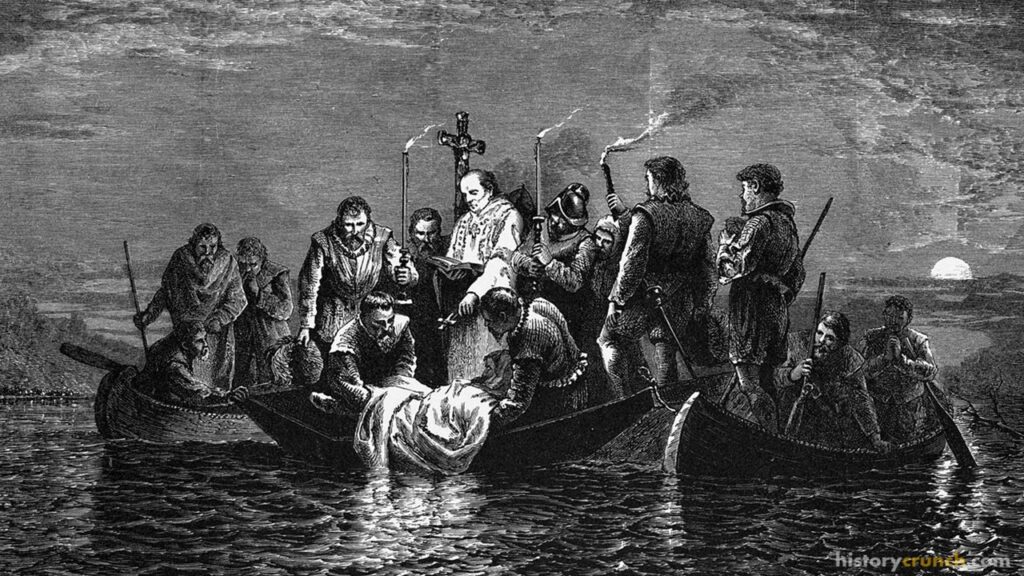
In 1541, de Soto became the first European to see the Mississippi River. This was a significant geographical achievement at the time. Despite this, he never found the riches he was searching for. Ultimately, the expedition struggled due issues including starvation, disease and resistance from Native Americans. De Soto died of fever on May 21st in 1542 near the Mississippi River in present-day Louisiana or Arkansas. His remaining men, now leaderless and diminished, buried his body in the river to prevent local tribes from discovering his death, fearing it would encourage rebellion.
HERNANDO DE SOTO – SIGNIFICANCE
Hernando de Soto was one of the most significant explorers during the time of the Age of Exploration. In fact, de Soto’s expedition provided the first European contact with the interior of the southeastern United States. As such, his expedition significantly expanded European knowledge of North American geography. For example, his journey mapped major rivers, forests, and regions previously unknown to Europeans. This laid the foundation for future explorers and colonizers in the New World.
With that said, de Soto’s expedition also had a tremendously negative impact on the Native American peoples. For instance, the expedition was marked by widespread violence and destruction, which was typical of Spanish conquests during the period. Many of de Soto’s interactions with Native Americans resulted in armed conflict, mass killings, and the destabilization of entire communities. Furthermore, like other European expeditions, de Soto and his men inadvertently spread European diseases such as: smallpox and measles. These diseases devastated indigenous populations who had no immunity. This destroyed entire communities of indigenous people, who were left to deal with the consequences of the destruction. As such, de Soto is a controversial figure in history. Some celebrate him as a brave explorer in a difficult time, while others criticize his violent methods and overall negative impacts.