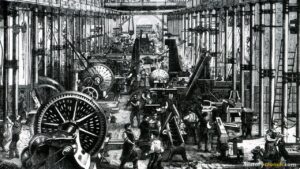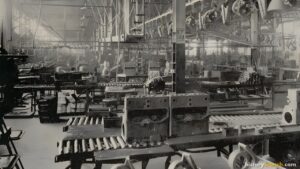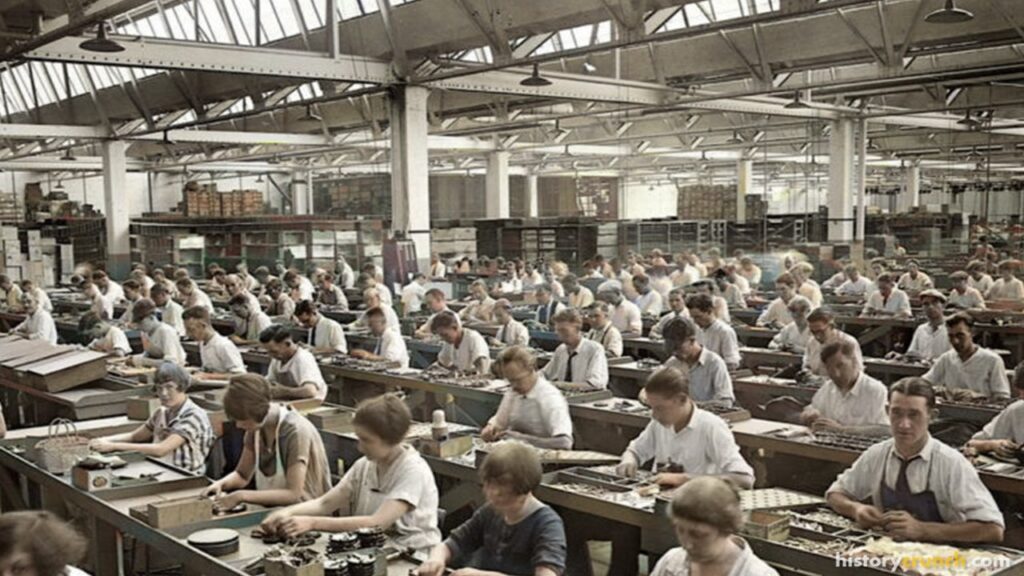
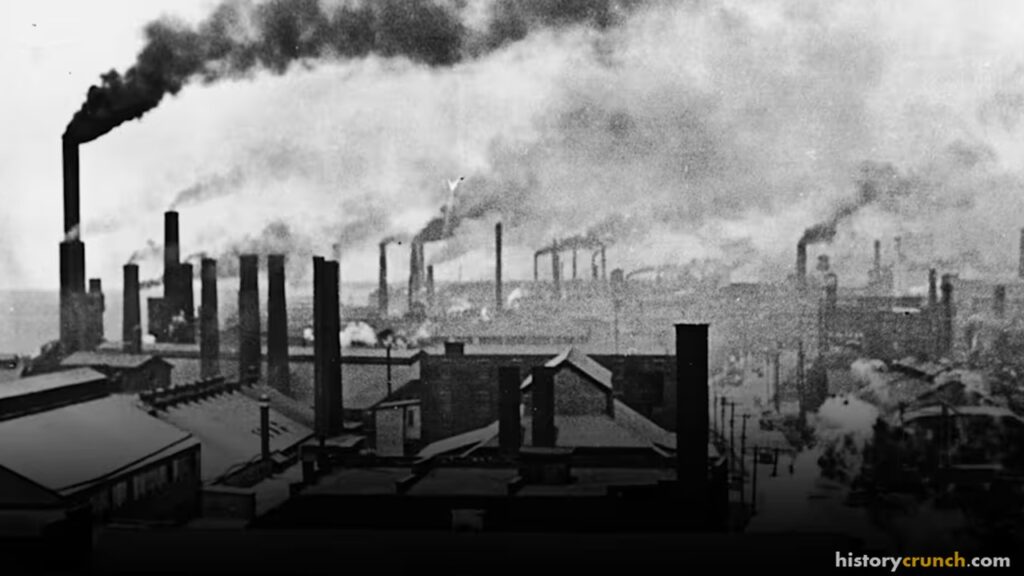
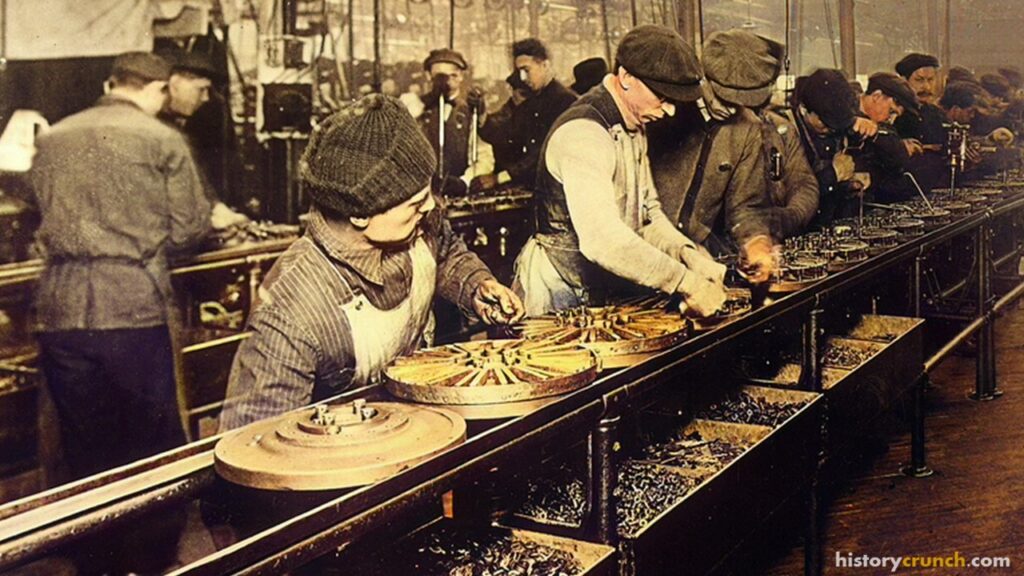
One of the main features of the Industrial Revolution was the horrendous working conditions that people faced. At the time, industrial cities and towns grew dramatically due to the migration of farmers and their families who were looking for work in the newly developed factories and mines. These factories and mines were dangerous and unforgiving places to work in. The working conditions that working-class people faced were known to include: long hours of work (12-16 hour shifts), low wages that barely covered the cost of living, dangerous and dirty conditions and workplaces with little or no worker rights.
 FactsthatCrunch
The Factory Act of 1833 banned children under nine from working in textile mills, yet it said nothing about mines, where children as young as five continued to haul coal in total darkness until a separate law passed in 1842.
Earlier laws in 1802 and 1819 had tried to protect mill children, but almost nothing enforced them. The 1833 act set a maximum of nine hours a day for children aged nine to thirteen and hired the first paid factory inspectors to check on mills. Mines were left out entirely, and it took nine more years and a shocking government report in 1842 before women, girls and boys under ten were banned from working underground.
What Led to the Working Conditions in the Industrial Revolution?
To better understand the situation, it’s first important to understand the political ideology of the time, which historians refer to as classical liberalism. Classical liberalismA political ideology of the time that supported minimal government involvement in the economy and society. is an ideology characterized by laissez-faire capitalism, which means that the government played as little a role in the economy as possible. As a result, there were little to no rules in place for workers in the Industrial Revolution, and the wealthy owners could act in any manner that they wanted. For example, the factories and mines were incredibly dangerous places with very few safeguardsSafety measures or protections designed to prevent workers from being hurt on the job..
 FactsthatCrunch
Long Hours of Work
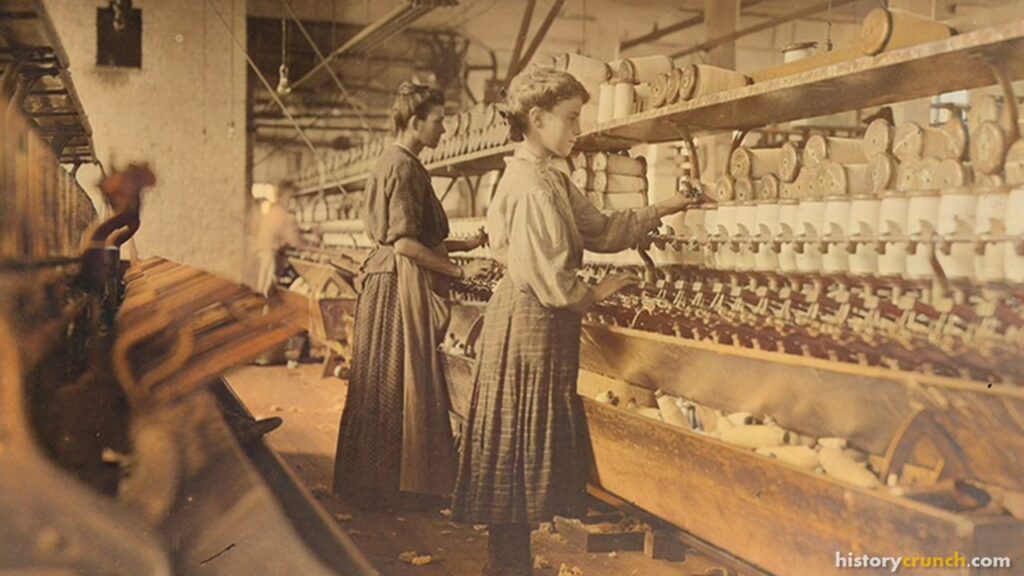
The first main feature of industrial workplaces was the long hours of work. It was not uncommon for workers to be expected to work shifts of 16 hours per day in grueling conditions. The work was labor intensiveWork requiring great physical effort and repeated bodily actions over long periods of time. and required the workers to complete repetitive and tiring actions. As such, many of the workers were physically ‘burned out’ after a day of work. What made the situation worse was the lack of breaks during the long shifts. Often workers were denied their breaks or were deducted pay for taking a break. As well, they were also sometimes required to clean the machines during their meals.
 FactsthatCrunch
The British government followed classical liberalism, a political idea that kept the government out of the economy, so factory owners faced no laws limiting how many hours workers had to be on the job.
Classical liberalism supported laissez-faire capitalism, meaning the government left business owners free to set their own rules. Workers had no legal protections, so long shifts and dangerous conditions went unchecked until labor reform movements pressed governments to act.
Low Pay / Wages
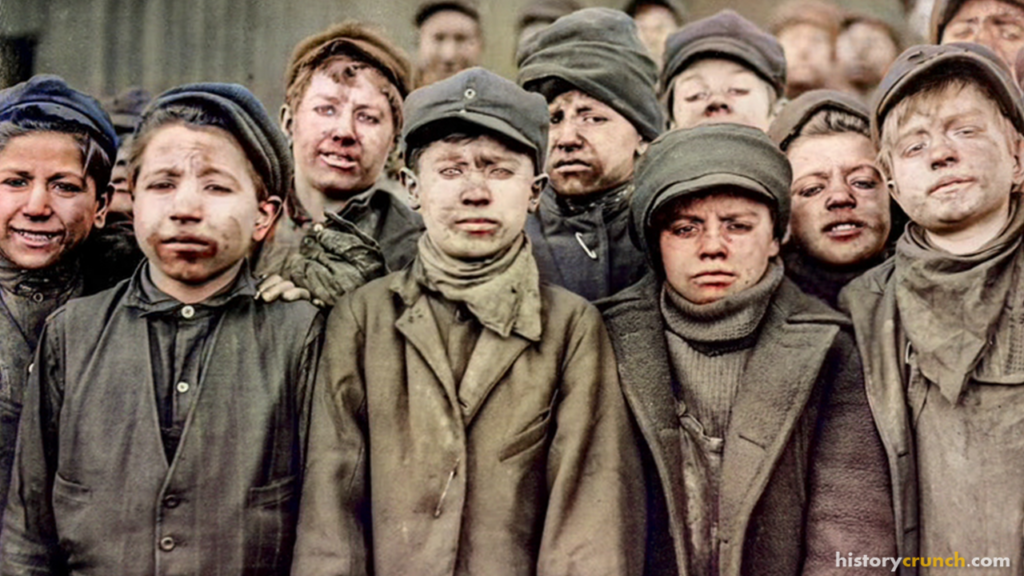
The next aspect of the working conditions that industrial workers were forced to endure was the low wages of pay. In general, industrial workers were paid very small amounts and struggled to survive. For example, adult men were paid around 10 shillings per week, while women were paid 5 shillings for the same work, and children were paid just 1 shilling. In comparison, rent alone took a large share of what a family earned each week. This did not usually leave much left over for food, clothes and luxury items. As a result, they often struggled to cover their cost of living and had to also endure difficult living conditions. As well, workers often had their pay deducted for being late or for taking a break during their shift. The level of pay was so poor that many working-class families needed their children to work as well, in order to help cover the costs of the family. For their part, factory and mine owners were eager to hire children since they cost less to employ, and they could often be used for certain work due to their size. As a result, child labor was common during the Industrial Revolution.
 FactsthatCrunch
Men were paid roughly twice what women received and about ten times what children received, yet even men's wages left little for a family once rent and food were paid. The gap shows how factory and mine owners used gender and age to keep overall labor costs as low as possible. No legal minimum wage existed to protect any of these workers from being underpaid.
Dirty and Dangerous Workplaces
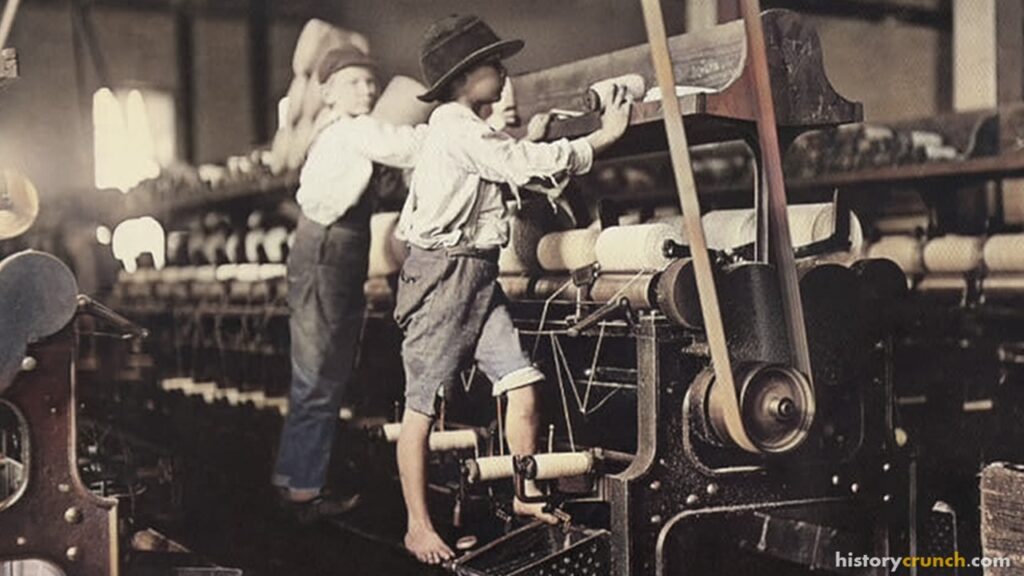
The third feature of workplaces in the Industrial Revolution was the dirty and dangerous conditions that workers were expected to endure during their shifts. For example, factories of the Industrial Revolution were notorious for being dangerous, especially textile mills. Spinning machines in textile mills were often left unguarded and posed a serious risk. For instance, a report from the British House of Commons in 1832 commented that “There are factories, no means few in number, nor confined to the smaller mills, in which serious accidents are continually occurring, and in which, notwithstanding, dangerous parts of the machinery are allowed to remain unfenced.” This situation caused industrial workers to become injured, as they were working dangerously close to spinning belts and shafts that powered the machines. Any loose fitting clothing could easily become clogged and pull the worker violently into the workings of the machine. Furthermore, the factories of the Industrial Revolution were known for the excruciating heat. Factories in the Industrial Revolution were cramped and contained spaces. Often times, they were built without windows or proper ventilationA system that allows fresh air to flow through a building, preventing dangerous heat buildup. and as a result the machines would quickly cause the inside temperature of the factory to increase dramatically. All of this combined to create a horrendous situation for the workers.
 FactsthatCrunch
There are factories, by no means few in number, nor confined to the smaller mills, in which serious accidents are continually occurring, and in which, notwithstanding, dangerous parts of the machinery are allowed to remain unfenced.
What does this passage from the 1832 report suggest was the main reason dangerous machinery went unguarded in British factories?
Lack of Rights
The final aspect of the working conditions that people faced in the Industrial Revolution was the lack of rights. As previously stated, the political ideology of the time was classical liberalism. This was a highly individualistic ideology that was based on little or no government involvement. As a result, this meant that the government did little to protect workers from being exploitedTreated unfairly by powerful people who take advantage of someone’s weak position for their own gain. by the wealthy entrepreneurs of the time. For example, child labor was a common feature of life in the Industrial Revolution. Since there were no child labor laws at the start of the Industrial Revolution, factory and mine owners were free to hire children and employ them in incredibly dangerous situations.
Furthermore, in modern society, governments are often responsible for establishing minimum wage laws in order to protect workers from being underpaid. However, during the Industrial Revolution, no such laws existed and as a result, industrial workers barely made enough to cover their cost of living. Another example of how workers lacked rights was in regards to how they were treated if they were injured while at work. As discussed in the previous paragraph, the workplaces of the Industrial Revolution were incredibly dangerous and workers often suffered from horrible injuries that made it impossible for them to keep working. Because the government practiced laissez-faire capitalism, this meant that they did not have initiatives in place to force factories to protect workers or to compensate them when they became injured and could no longer work. For example, a report from the British House of Commons in 1832 commented that “workers are often abandoned from the moment that an accident occurs; their wages are stopped, no medical attendance is provided, and whatever the extent of the injury, no compensationMoney or support given to a worker who has been harmed or can no longer do their job. is afforded.” Therefore, workers lacked basic rights in regards to protecting themselves from harm and in regards to receiving assistance after they were injured.
Working Conditions in the Industrial Revolution – Summary
In conclusion, the lives of industrial workers in the Industrial Revolution were difficult. They were expected to endure long hours of work for very little pay and were often placed in incredibly dirty and dangerous situations. As well, they lacked the basic rights necessary to fight for better conditions. Regardless, the harsh working conditions of the Industrial Revolution eventually led to the labor movement and the American Labor Movement, which sought to give rights and protections to working-class people.
 FactsthatCrunch
By the early 1800s, factory and mine workers across Britain and the United States were enduring 12 to 16-hour shifts, wages too low to cover basic living costs, and workplaces where injuries left them with no pay and no medical help. A British House of Commons report in 1832 documented that injured workers were abandoned the moment an accident occurred, with wages stopped and no compensation offered. Workers were growing more desperate, and the question of what they would do next shaped the future of industrial societies.
Key Vocabulary
Classical liberalism
Laissez-faire capitalism
Labor intensive
Safeguards
Ventilation
Exploited
Compensation
Frequently Asked Questions
How many hours did factory workers work during the Industrial Revolution?
Factory workers often worked shifts of 12 to 16 hours each day. The labor was repetitive and tiring, which left many workers physically burned out. Breaks were rare, and workers were sometimes denied them or had their pay deducted for taking one.
Why were working conditions so bad during the Industrial Revolution?
Conditions were harsh because the government followed an ideology called classical liberalism. This idea supported laissez-faire capitalism, which meant the government stayed out of the economy. As a result, there were few rules protecting workers, so wealthy owners could act however they wanted.
How much were workers paid in the Industrial Revolution?
Adult men were paid around 10 shillings per week, while women earned 5 shillings for the same work. Children were paid just 1 shilling for their labor. After paying rent, families had little left for food and clothing.
Why was child labor common during the Industrial Revolution?
Child labor was common because families were paid so little that they needed their children to work too. Factory and mine owners were also eager to hire children since they cost less to employ. Their small size let them do certain tasks, and no child labor laws existed at first.
What happened to workers who got injured on the job?
Injured workers were often left with no help at all. A report from the British House of Commons in 1832 noted that wages were stopped, no medical care was given, and no compensation was offered. Because the government practiced laissez-faire capitalism, it did not force factories to protect or support workers.
What did the harsh working conditions eventually lead to?
The harsh conditions eventually helped spark the labor movement. Workers began to organize to demand better pay, safer workplaces, and basic rights. This effort included the American Labor Movement, which sought protections for working-class people.
Cite This Article
To cite this article as a source, use one of the formats below.
MLA: Beck, Elias. “Working Conditions in the Industrial Revolution: A Detailed Summary.” HistoryCrunch, 25 September 2026, https://historycrunch.com/working-conditions-in-the-industrial-revolution/.
APA: Beck, E. (2026). Working Conditions in the Industrial Revolution: A Detailed Summary. HistoryCrunch. https://historycrunch.com/working-conditions-in-the-industrial-revolution/
Chicago: Beck, Elias. “Working Conditions in the Industrial Revolution: A Detailed Summary.” HistoryCrunch. September 25, 2026. https://historycrunch.com/working-conditions-in-the-industrial-revolution/
Sources
- Robert C. Allen, The Industrial Revolution: A Very Short Introduction.
- Fordham Modern History Sourcebook
- The Science Museum Group