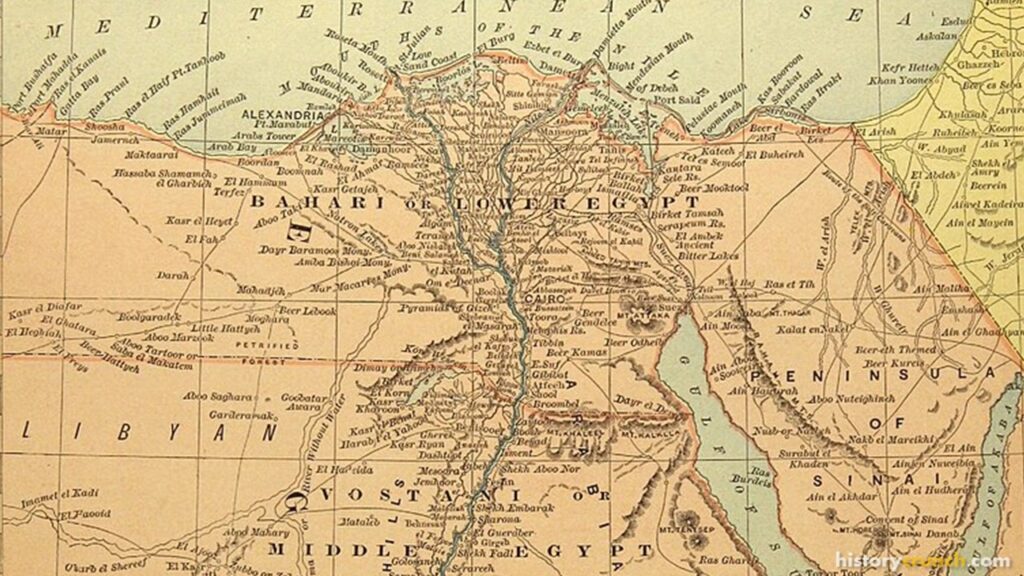
The Suez Canal was an important waterway in Egypt and a significant site in the Age of Imperialism. More specifically, European nations such as Britain and France fought over control of the Suez Canal, as it proved to be a strategicGiving an important military or political advantage to whoever controls it. waterway for imperialisticRelated to a powerful country taking control of weaker countries for political or economic gain. campaigns. As such, historians consider the history of the Suez Canal to be significant to the European imperialism in Africa (Scramble for Africa) and British Imperialism in India.
 FactsthatCrunch
Why did the Suez Canal matter so much to Britain and France as a route to Asia?
Early European Interest in Egypt
Northern Africa had a long history of contact with European nations, even dating back to ancient times. However, true European imperialism began when Napoleon Bonaparte invaded Egypt with his French forces in 1798. Napoleon invaded the region with thousands of troops and hundreds of warships. As well, he brought along a group of scientists in order to study the culture and ancient artifacts of Egypt. Napoleon’s goal was to invade Egypt in order to limit British influence in the region and promote French political and economic interests. Despite many victories on land, the French were eventually forced out of Egypt. In August of 1798, the British navy destroyed the French fleet at the Battle of the Nile, which left the French army stranded in Egypt. The last French troops surrendered to British and Ottoman forces in 1801. Napoleon himself had already returned to France in 1799, where he famously overthrew the French government to begin his own reign.
FactsthatCrunchIn the summer of 1798, Napoleon Bonaparte led French forces into Egypt, bringing thousands of troops, hundreds of warships, and a team of scientists to study Egyptian culture and ancient artifacts. His goal was to limit British influence in the region and advance French political and economic power in North Africa.
North Africa had long contact with Europe, but no modern European power had launched a full military campaign to take control of Egypt
France's invasion opened North Africa to European imperial ambitions, setting a pattern of military force and political competition that shaped the region for the next century. The British navy destroyed the French fleet at the Battle of the Nile in August of 1798, and the last French troops in Egypt surrendered in 1801.
Construction of the Suez Canal
Other than Napoleon’s early campaign, Europeans generally had little interest in Egypt until 1859 when the construction of the Suez Canal began, which connected the Mediterranean Sea with the Red Sea. This was an important moment in the Egyptian 19th century history, as it saw the European nations take an increased interest in the northern African nation. This is because the Suez Canal allowed for much shorter trips to Asia from Europe. Previously, ships would have to travel the entire way around Africa in order to make the journey to the Far East. This was especially significant at the time, due to the Age of Imperialism and European interest in both India and China. More specifically, the British had a keen interest in the Suez Canal due to their colonization in India, while the French were interested due to their control over regions in Southeast Asia and the South Pacific.
The Suez Canal Company (also called the ‘Universal Company of the Maritime Canal of Suez’) carried out the construction of the Suez Canal from 1859 until 1869. At first, the company was funded and controlled by French investors, which gave France an early imperialistic advantage in Egypt. In fact, Ferdinand de Lesseps, who was a French diplomat and developer, headed the Suez Canal Company. As stated above, it took the Suez Canal Company approximately a decade to complete the Suez Canal, and it was finally opened on November 17th in 1869. The canal remained under the control of the French via the Suez Canal Company for the first number of years. However, it changed to Britain when it took over Egypt in 1882.
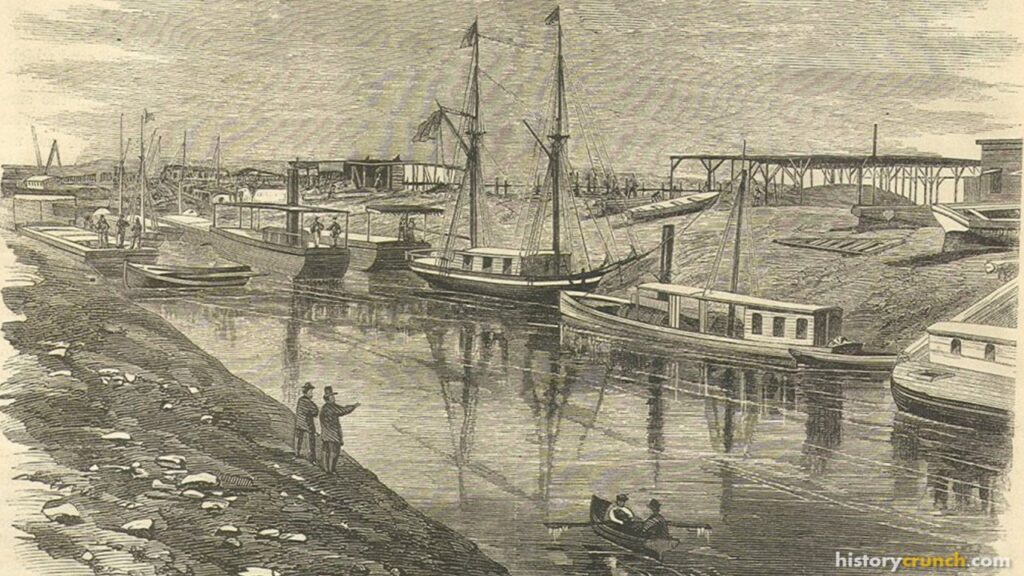
FactsthatCrunchThe Suez Canal has no locks. The Mediterranean Sea and the Red Sea sit at almost the same level, so ships sail straight through.
When it opened in 1869, the canal was about 100 miles long. It cut thousands of miles off the trip from Europe to India, because ships no longer had to sail around Africa.
British Imperialism in Egypt
As stated above, British control over Egypt began in 1882. In reality, the British had begun to increase their influence in Egypt in the decade before by taking on a large financial interest in the Suez Canal. Due to the vast British Empire, and its overwhelming naval power, Britain had a keen interest in controlling the Suez Canal. In fact, British imperialism in India was a key reason for British interest in Egypt, since the Suez Canal gave Britain a quicker and more direct route to its colonies in the Far East. For instance, the British began to refer to the Suez Canal as the ‘lifeline of the British Empire’.
In 1881, Egypt underwent major upheavalsSudden and violent changes in a government or society that cause major disorder. in terms of its government and society. More specifically, the government of Egypt, headed by Tewfik Pasha, experienced an uprising led by army officer Ahmed Urabi and other Egyptian nationalists. The outpouring of nationalism eventually led to the European nations and Tewfik Pasha losing control over large sections of the country. The nationalistA person who strongly supports their own country’s independence and wants to remove foreign control. movement in Egypt aimed at removing Tewfik Pasha from power, and removing European influence from the country. This caused the British to respond militarily in Egypt in order to help reinstateTo put someone back into a position of power they had previously lost. Tewfik Pasha. The British did this out of fear of the nationalists gaining full control over the country and the Suez Canal.
As such, the British organized its forces and carried out the Anglo-Egyptian War from July to September in 1882. The British easily defeated the Egyptian nationalists and restored Tewfik Pasha to power. However, the victory also led to British control over the Suez Canal. Britain continued its influence in Egypt by carrying out several major projects to boost Egyptian economic activity, such as its cotton production. Egypt became a protectorateA country that keeps its own government but is heavily controlled and ‘protected’ by a stronger foreign power. of the British Empire, which meant that while Egypt had its own government it was still heavily influenced and controlled by the British. As such, the British considered Egypt to be under its ‘protection’ and guided the African nation in ways that best suited the British. Officially, Egypt remained part of the Ottoman Empire until 1914, when Britain formally declared it a protectorate. British rule over Egypt continued throughout the remainder of the 19th century and well into the 20th century. For instance, Britain took even more control over Egypt in 1914, with the outbreak of World War I. In the end, Britain did not formally leave Egypt until June of 1956.
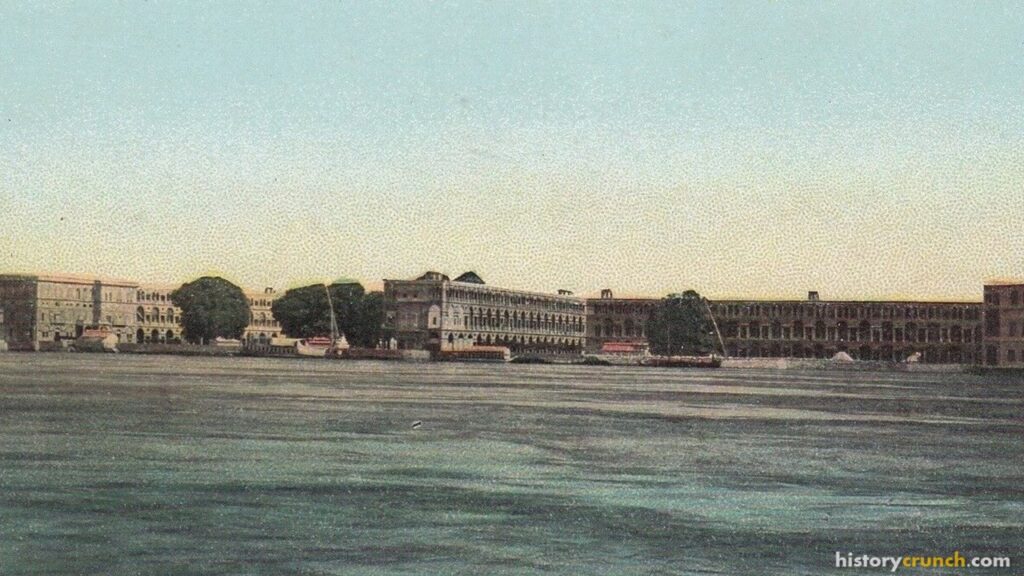 FactsthatCrunch
How did Britain gain a stake in the Suez Canal before it took over Egypt?
In 1875, Britain bought Egypt’s shares in the Suez Canal Company for about 4 million pounds. Prime Minister Benjamin Disraeli arranged the deal quickly, using a loan from the Rothschild banking family. It made Britain the largest single shareholder in the canal, seven years before British troops took control of Egypt in 1882.
Explore Age of Imperialism · 1870 – 1914
Keep exploring Age of Imperialism with these History Crunch resources.
Key Vocabulary
Imperialistic
Protectorate
Nationalist
Upheavals
Reinstate
Strategic
Frequently Asked Questions
What is the Suez Canal and why was it important?
The Suez Canal is a waterway in Egypt that links the Mediterranean Sea with the Red Sea. It let ships sail from Europe to Asia without going all the way around Africa. This made trade and imperial travel much faster, which is why European powers wanted to control it.
When was the Suez Canal built and who built it?
The Suez Canal was built between 1859 and 1869 by the Suez Canal Company. The company was first funded and run by French investors, which gave France an early edge in Egypt. Ferdinand de Lesseps, a French diplomat and developer, led the project, and the canal opened on November 17th, 1869.
Why did Napoleon invade Egypt in 1798?
Napoleon Bonaparte invaded Egypt in 1798 to limit British influence and boost French political and economic interests. He brought thousands of troops, hundreds of warships, and a group of scientists to study the culture. The British defeated his fleet at the Battle of the Nile, and his forces later had to withdraw.
How did Britain gain control of the Suez Canal?
Britain gained control of the Suez Canal in 1882 after taking over Egypt. In the 1870s, Britain had already built up a large financial stake in the canal. A nationalist uprising in 1881 led to the Anglo-Egyptian War, and Britain’s victory gave it control of the waterway.
Why did Britain call the Suez Canal the “lifeline of the British Empire”?
Britain called the Suez Canal the “lifeline of the British Empire” because it gave a quicker route to its colonies in the Far East. British imperialism in India made this fast route very valuable. The canal connected the heart of the empire to its distant holdings across Asia.
When did Britain leave Egypt?
Britain did not formally leave Egypt until June of 1956. Egypt had become a British protectorate, meaning it kept its own government but was still heavily controlled by Britain. British power grew even stronger in 1914 with the outbreak of World War I.
Cite This Article
To cite this article as a source, use one of the formats below.
MLA: Beck, Elias. “Egypt and the Suez Canal in the Age of Imperialism: A Detailed Summary.” HistoryCrunch, 28 October 2026, https://historycrunch.com/egypt-and-the-suez-canal-in-the-age-of-imperialism/.
APA: Beck, E. (2026). Egypt and the Suez Canal in the Age of Imperialism: A Detailed Summary. HistoryCrunch. https://historycrunch.com/egypt-and-the-suez-canal-in-the-age-of-imperialism/
Chicago: Beck, Elias. “Egypt and the Suez Canal in the Age of Imperialism: A Detailed Summary.” HistoryCrunch. October 28, 2026. https://historycrunch.com/egypt-and-the-suez-canal-in-the-age-of-imperialism/
Sources
- State Department: Office of the Historian
- John Darwin, After Tamerlane / Unfinished Empire.
- Fordham Modern History Sourcebook