The Columbian Exchange is one of the most significant events in all of world history. It led to a major transformation between the New and Old Worlds that fundamentally changed the way of life for people across the entire world.
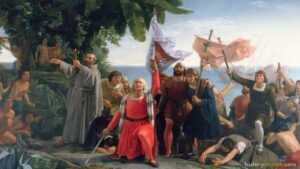
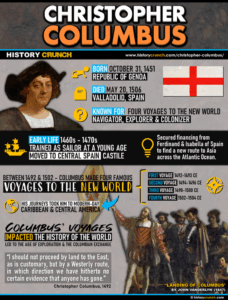
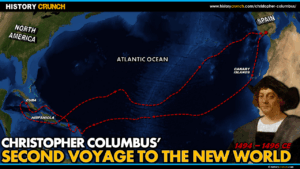
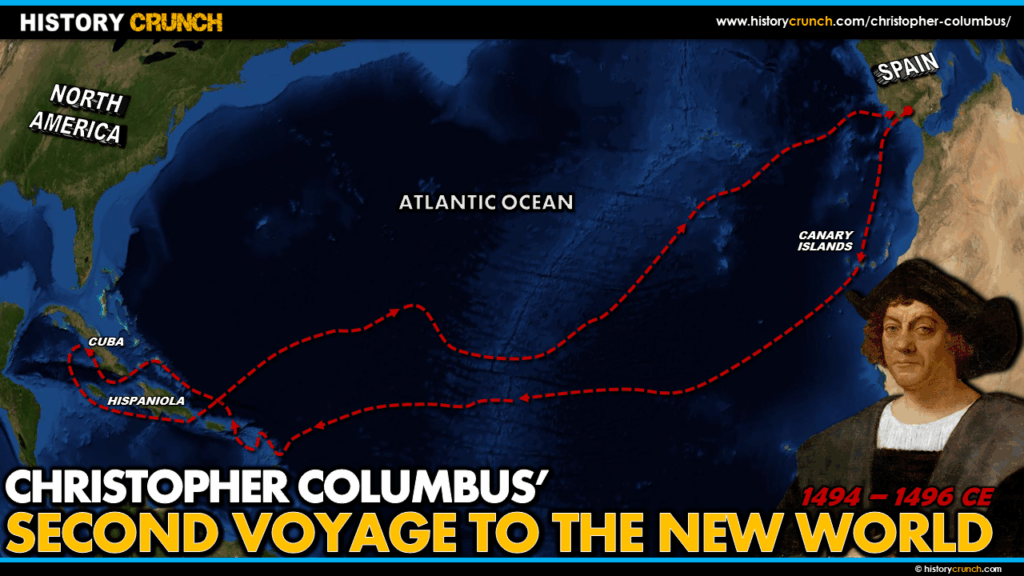
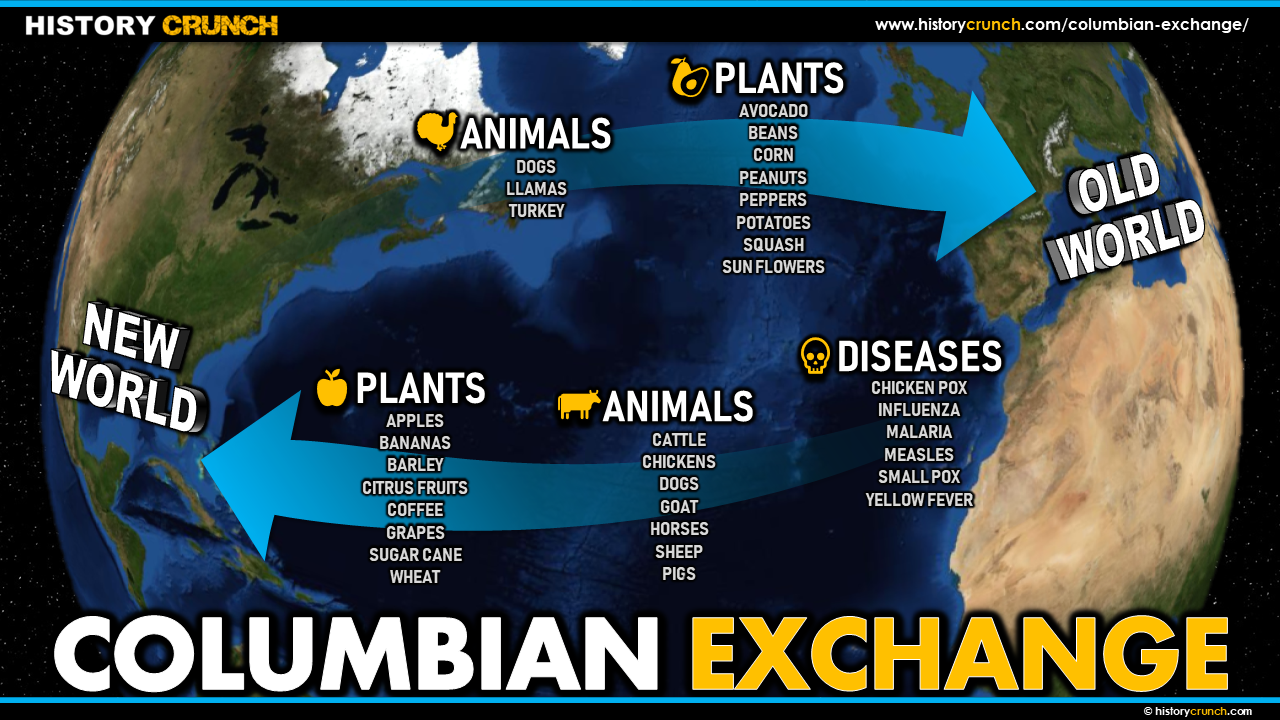
When Christopher Columbus set sail to the Americas in 1493 on his second voyage he brought with him many seeds, plants and livestock. This cargo started a ‘grand exchange’ and revolution between the New World and the Old World that would alter the world forever because he had brought with him seeds, plants and livestock that were not originally occurring in the New World. This exchange would be called the ‘Columbian Exchange’ by historian Alfred Crosby. The major exchange between the two worlds centered on the exchange of plants, animals, and diseases. Although the exchange began with Christopher Columbus it continued and developed throughout the remaining years of the Age of Exploration. Ultimately the Columbian Exchange impacted the social and cultural makeup of both sides of the Atlantic and dramatically impacted the people living in these regions. The information below details the exchange that occurred between the New and Old World as related to plants, animals and diseases.
 FactsthatCrunch
Crosby argued that Columbus's voyages set off a massive, lasting transfer of plants, animals, diseases, and cultures between the Old World and the New World. He named this process the Columbian Exchange to make clear that Christopher Columbus's arrival in 1492 was the trigger point for changes that reshaped life on both sides of the Atlantic. Crosby believed that bringing biology into the study of history was the key to understanding why those changes ran so deep and proved so permanent.
Columbian Exchange – Plants
The plants involved in the Columbian Exchange dramatically changed both the economy and culture of the New and Old Worlds. European explorers returned home with New World plants, such as: beans, squash, chili peppers, sunflowers, peanuts, tomatoes, sweet potatoes, avocado and pineapple. However, the two most important New World plants were the potato and maize (corn). They would eventually have profound effects on the Old World and modern peoples.
Maize (corn) is an important New World crop involved in the Columbian Exchange. It was always important to the societies of Central America because it could be dried and stored for long periods of time. It was easily transported to Europe because of its adaptable nature and would eventually be grown in many different regions around the world. The introduction of maize into the Old World, along with other New World foods, led to a population growth as the new foods helped support larger societies.
Potatoes are native to South America but were transported to the Old World where they would become a key component of the diet of many Europeans for years to come. The potato was important because it could resist cold temperatures and grow in relatively thin soil. Specifically, the potato would be vital to Ireland in particular and by the 19th century, Ireland was so dependent on the potato as a source of food that the “Irish Potato Famine” in the 1840’s and 1850’s caused mass starvation and emigrationLeaving one’s home country to go live permanently in another place. from Ireland. Approximately two-fifths of the population was solely reliant on the potato as a source of food, and when a potato disease destroyed the crops it had dramatic effects for Ireland and Irish people. Ireland’s population dropped approximately 20% to 25% between the years of the famine.
Many Old World plants were brought to the New World and would have a dramatic impact on the Americas. Most importantly, Old World crops like wheat and barley became stapleA crop that is a basic, everyday food that people depend on regularly. growing crops on the American prairies. A more specific example of an Old World crop was the sugarcane. The sugarcane was a very significant crop historically. Christopher Columbus introduced the crop to the Caribbean on his second voyage to the Americas. The new crop flourished in the New World with sugarcane plantations being developed in Cuba, Puerto Rico and Jamaica. Sugar today is used in many foods and has since become one of the largest cash cropsA plant grown mainly to be sold for money rather than eaten by the farmer. in history.
Coffee had been grown in Africa and the Middle East before it was transported to the Americas. Once in the New World, coffee became an important new crop in Central and South America. It has continued to be an important crop of the region due to its ability to grow easily in the climate of Central and South America. Today coffee is a popular drink around the world.
Columbian Exchange – Animals
Animals were another key component of the Columbian Exchange. The animals were transported by European sailors aboard early ships and would quickly impact the societies and environment of the Americas. The differences between the animals in the New and Old Worlds were dramatic with the indigenous peoples of the Americas only having a few animals for use. For example, indigenous peoples on the New World had only domesticated the dog and the llama. Prior to the Columbian Exchange, the Americas had no major beasts of burdenLarge animals used to carry loads or do heavy work that humans would otherwise do by hand. (work animals) and therefore all manual labor had to be completed by human hands. On Columbus’ second voyage in 1493 he brought a variety of Old World livestock, including: horses, pigs, sheep, dogs, cattle, chickens, and goats. When explorers brought new animals across the Atlantic, it introduced a whole new means of transportation, a new labor form, and new sources of food.
Pigs were extremely successful in the New World after being introduced by early European explorers and became very important to the Americas. For example, the pigs reproduced very fast and were able to serve as meat for early explorers and other societies. Specifically, Hernando de Soto brought thirteen pigs with him to Florida and within three years the pigs had reached a population of over 700.
Horses were extremely plentiful in Europe, especially in Spain and Portugal. The first horses arrived in the Americas with Columbus aboard his second voyage in 1493. The early European explorers brought horses across the Atlantic despite the difficulties of the voyage because horses served such an important function in the life of Europeans. The explorers used the horse successfully in battle against the indigenous peoples of the Americas and were tremendously helpful because the indigenous cultures had never experienced an animal as large as a horse in battle before. Horses today are common in the Americas and exist both as a work animal for humans as well as a wild animal.

Columbian Exchange – Diseases
Another major aspect of the Columbian Exchange was the spread of diseases around the world between the Old World and the New World. When Christopher Columbus made his voyage to the New World in 1492 unbeknownst to him he and his crew brought a series of diseases that would be devastating to the indigenous peoples of the New World. In particular, the European explorers transmitted smallpoxA highly contagious Old World disease that killed a vast number of indigenous people in the Americas after European contact. to the indigenous peoples, which the indigenous peoples did not have immunityThe body’s natural ability to resist and fight off a particular disease without getting seriously ill. to and thus resulted in a large number of deaths among the indigenous peoples in the Americas.
Historians disagree on how many indigenous people of the Americas died as a result of European diseases with estimates ranging from as low as 50% to as high as 90%. Regardless, the spread of European diseases had a dramatic effect on the societies and cultures of indigenous peoples. While smallpox was the most deadly of European diseases, it was not the only disease that spread to the New World. Other common Old World diseases included: measles, malaria, yellow fever, influenza and chicken pox.
The nature of the Columbian Exchange was that the ‘exchange’ occurred both ways between the New and Old Worlds. Therefore, some diseases also spread from the New World to the Old World. For example, some historians have argued that syphilis originated in the New World and returned to Europe when European explorers contracted the disease and then returned to Europe. Also, New World diseases also made their way to Europe when indigenous peoples were brought back to Europe on the return voyages.
With that said, New World diseases did not devastate Europe, Asia or Africa the way Old World diseases devastated the indigenous peoples of the New World. The indigenous population of the New World was impacted for several reasons. Firstly, the indigenous peoples had no prior exposure to the Old World diseases and therefore their immune systems were not fully prepared to fight the new diseases. Secondly, most of the European diseases were transmitted by air and touch making them spread quickly and easily among the people.
 FactsthatCrunch
Why did diseases such as smallpox kill so many Indigenous people in the Americas after 1492?
Indigenous peoples of the Americas had never been exposed to Old World diseases such as smallpox, measles, and influenza, so they had no immunity to them. Historians estimate that between 50 and 90 percent of Indigenous people died from these diseases, which deeply damaged their societies and cultures.
Explore Age of Exploration · 1415 – 1600 CE
Keep exploring Age of Exploration with these History Crunch resources.
Key Vocabulary
Beasts of burden
Staple
Cash crop
Immunity
Smallpox
Emigration
Frequently Asked Questions
What was the Columbian Exchange?
The Columbian Exchange was the large transfer of plants, animals, and diseases between the New World and the Old World. It began when Christopher Columbus sailed to the Americas and brought seeds, plants, and livestock with him. This exchange changed daily life, diets, and populations on both sides of the Atlantic Ocean.
Who named the Columbian Exchange?
The historian Alfred Crosby named the Columbian Exchange. The term points to Christopher Columbus, whose voyages first linked the two worlds. Crosby used it to describe the movement of plants, animals, and diseases that followed those voyages.
What plants were traded in the Columbian Exchange?
The most important New World plants were the potato and maize, also called corn. Other New World plants included beans, squash, chili peppers, tomatoes, peanuts, and pineapple. In return, the Old World sent crops like wheat, barley, sugarcane, and coffee to the Americas.
How did the Columbian Exchange affect Native Americans?
European diseases killed a huge share of the indigenous peoples of the Americas. Smallpox was the deadliest, and estimates of deaths range from about 50% to 90% of the native population. Native peoples had no prior exposure to these diseases, so their bodies could not fight them off.
How did horses change life in the Americas?
Horses gave people in the Americas a new way to travel, work, and fight. The first horses arrived with Columbus on his second voyage in 1493. Native cultures had never seen such a large animal in battle, which gave European explorers a strong advantage.
Why was the potato so important to Europe?
The potato became a key food for many Europeans because it could survive cold weather and grow in thin soil. Ireland grew so dependent on it that a crop disease caused the Irish Potato Famine of the 1840s and 1850s. That famine led to mass starvation and dropped Ireland’s population by about 20% to 25%.
Cite This Article
To cite this article as a source, use one of the formats below.
MLA: Beck, Elias. “Columbian Exchange: A Detailed Summary.” HistoryCrunch, 23 October 2026, https://historycrunch.com/columbian-exchange/.
APA: Beck, E. (2026). Columbian Exchange: A Detailed Summary. HistoryCrunch. https://historycrunch.com/columbian-exchange/
Chicago: Beck, Elias. “Columbian Exchange: A Detailed Summary.” HistoryCrunch. October 23, 2026. https://historycrunch.com/columbian-exchange/
Sources
- Gilder Lehrman Institute
- Fordham Modern History Sourcebook
- J.H. Parry, The Age of Reconnaissance.
- Alfred W. Crosby, The Columbian Exchange.